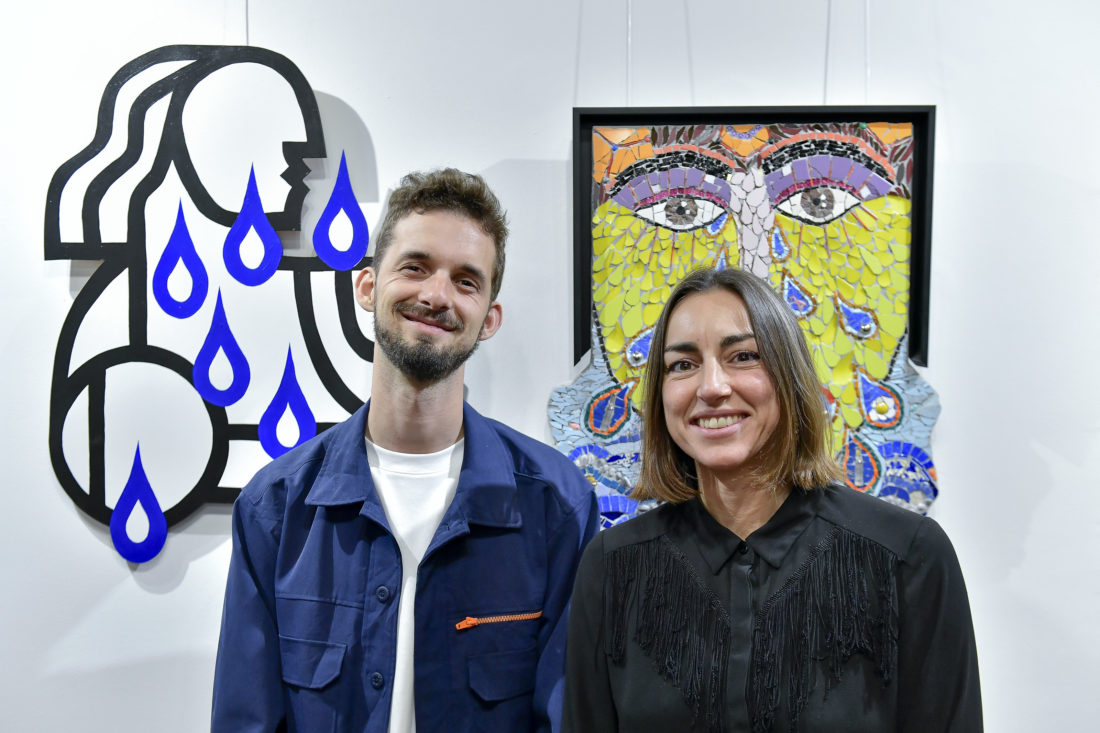
The title “Complex Complexities” speaks of a balance between two opposites. What does it represent for both of you?
ALSo:
When we were searching for the exhibition title, we explored oxymorons. This one resonated with us because we wanted to show — and I hope we succeeded — that even with opposing universes, we can still meet in the middle and create something harmonious. And I think it echoes what we experience today: we can have very different opinions or profiles and still manage to talk to each other and build together. It carries almost a societal meaning.
Bleg:
For me, the idea was to find a title built on a strong opposition, since our artistic worlds are completely different. My work is very graphic: I strive for simplicity, for fine balances with very few elements. On the contrary, mosaic is an accumulation of small objects, tiny fragments, pieces of glass or stone that together form a unified whole. We found it interesting to oppose two words just as our styles are very far from each other. The idea was really to create an oxymoron.
Your universes are very different, yet they resonate with each other. How did you find your meeting point?
ALSo: I’d say we gave ourselves the means to push our interpretations far. Some pieces are reinterpretations of each other’s works. We didn’t set limits: Bleg trusted me, and I trusted him. We didn’t impose directions or specific elements referring to our personal work. That mutual trust was, I think, incredibly beneficial in helping us meet in the artworks.
Bleg:
Quite simply, by exchanging works to reinterpret them. A bit like the Rosetta Stone made hieroglyphs readable, the double reading of the same subject — for example, the reinterpretation of Bathers at Asnières — helped us better understand each other’s artistic language. We also allowed ourselves to give the other a half-finished piece and let them intervene freely. That’s how ALSo, starting from a wood drawing, created volumes for Isis.
How did you imagine the scenography so your works could interact within the space?
ALSo:
We balanced the works. With an even number, we had four collaborative works and four reinterpretations. That already created a form of balance — this “complex simplicity” — and it helped build the whole exhibition. Then we both wanted to work on sculptural pieces to occupy the central space of the gallery, including a four-hand volume piece designed also for the window area.
Working together inevitably means confronting different ways of doing things. What did this collaboration teach you?
ALSo: First, that it isn’t easy. There was a whole preparation phase I wasn’t used to — usually my exhibitions come from months of internal work. Here, for the reinterpretations, I had to find how to bring my own touch while respecting the identity of the other. At the same time, I was determined that mosaic should not become mere coloring or filling, and that really guided me. It wasn’t simple, but the trust we built made everything flow.
Bleg: When she told me, “I don’t want to do coloring,” it intrigued me. She did things I would never have imagined. She created volume out of a project that, in my head, was strictly 2D. It made me realize anything is possible — why stay stuck in 2D? It opened my vision, and I think it will give me new tools for the future.
ALSo — You work with fragments and recovered materials. What were you trying to express through these assemblages?
I’ll take a few examples.
For Isis, the drawing made by Bleg represents the Egyptian goddess. Through the mosaic, I added elements and small objects illustrating the powers Isis had at the time. The drawing provides the shape, and the mosaic enriches it by adding a narrative layer.
For the reinterpretation of The End of the Minotaur, I created The Minotaur’s Tears. There, I really focused on the meaning of Bleg’s painting rather than the lines themselves. I used letters made from beads to bring softness into the Minotaur’s world.
Your works are very colorful and luminous. How did you play with Bleg’s sobriety without losing your visual energy?
For me, sobriety was an interesting playground. It felt natural to move toward something simpler. And above all, Bleg never directed or limited me: he never told me how he wanted the mosaic to be integrated or interpreted. That gave me freedom to use colors, shapes, and complexity as I wished. The title Complex Simplicity also guided me: I embodied the complexity — so I embraced it fully.
Bleg — Your drawings go straight to the essential, with very few lines. Did working with ALSo change your idea of simplicity?
Not really, though her work did make me reflect. For example, The Waterfall: the image is simple, but when you look at the number of fragments and how each one is cut, you understand how complex it is. Yet the message comes across immediately. So maybe simplicity can come from an accumulation of complex elements.
I could incorporate that complexity into my own work while keeping my lines simple — by adding texture, layering materials… I already knew it, but this collaboration reinforced the idea.
You often work in large formats, murals. How did you experience this encounter in a more intimate and shared space?
I’ve worked on small formats before, so it didn’t change my habits too much. But working with materials was new for me. For instance, on The Prism: starting with three elements and then seeing this sort of flame grow inside… I wasn’t prepared for that. And I don’t think either of us really was.